Most B2B SaaS marketing plans still end at the signup. That made sense when growth money was cheap. Now it quietly hurts the business, because the real revenue shows up months after the first payment.
Here’s a scene we’ve watched play out more than once. Marketing reports a record quarter for trials and MQLs. Everyone claps. Then customer success shares the churn numbers, and half that growth disappears on the next slide.
So this guide takes a different view. It covers seven strategies that grow revenue across the whole customer lifecycle, from first search to renewal.
What Makes B2B SaaS Marketing Different
A SaaS deal isn’t really a sale. Instead, it’s the start of a subscription the customer can cancel every month or every year.
That single fact changes everything. For example, a buyer judges your trial the way they’d judge a new hire’s first week. Also, the person who signs the contract is often not the person who uses the product daily. So you need to win both of them.
And after the sale, the customer keeps deciding. Every login is a small vote on whether to renew.
In short, B2B SaaS marketing has to earn the first yes and then keep earning it.
The Math Every B2B SaaS Marketing Team Should Know
Before picking tactics, look at the numbers that shape SaaS growth right now.
New customers have become expensive. The median SaaS company now spends about $2.00 in sales and marketing to win $1.00 of new customer ARR. However, expansion revenue from existing customers costs about half that, at a median of $1.00.
Payback takes time too. Full-year 2025 data from 342 software companies puts median CAC payback at 16 months. Top-quartile companies recover it in six months or less, while the bottom quartile needs 24 months or more.
Meanwhile, median net revenue retention sits around 101%. In other words, the typical SaaS company barely grows its existing customer base after churn. Existing customers already generate about 40% of new ARR at the median, and over half for companies above $50M.
Still, the upside is huge when both sides work. In an analysis of 800+ SaaS companies, those with high NRR and strong CAC payback averaged 71% growth. Companies weak on both averaged just 10%.
So the lesson for B2B SaaS marketing is simple. Retention and expansion are marketing problems too, not just customer success problems.
1. Build Demand Around the Problem, Not the Product
Most SaaS content talks about features. But buyers don’t search for your feature names, because they don’t know them yet. Instead, they search for the problem that keeps annoying them.
Good SaaS demand generation starts there. For example, a finance automation tool shouldn’t lead with “AI-powered reconciliation.” It should lead with the pain: month-end close taking eight days when it should take three.
Then show the cost of that problem in numbers the buyer can take to their boss. Hours lost. Errors caught late. Deals delayed.
Also, create content for the moment just before a buyer starts looking. That includes benchmarks, calculators, and “how teams like yours handle this” guides. Since this content reaches buyers earlier, it builds pipeline your competitors can’t see yet. That’s the core of B2B demand generation: create interest before buyers start comparing vendors.
Common mistake: Gating every piece of early-stage content. Buyers at this stage aren’t ready to talk to sales, so a form just stops them from reading.
2. Score Leads on What They Do in the Product
Traditional lead scoring rewards activity like email opens and webinar attendance. But in SaaS, you have a much better signal: what people actually do in your product.
That’s the idea behind a product-qualified lead, or PQL. Instead of asking “did they download an ebook?”, you ask “did they reach the moment where the product proves its value?”
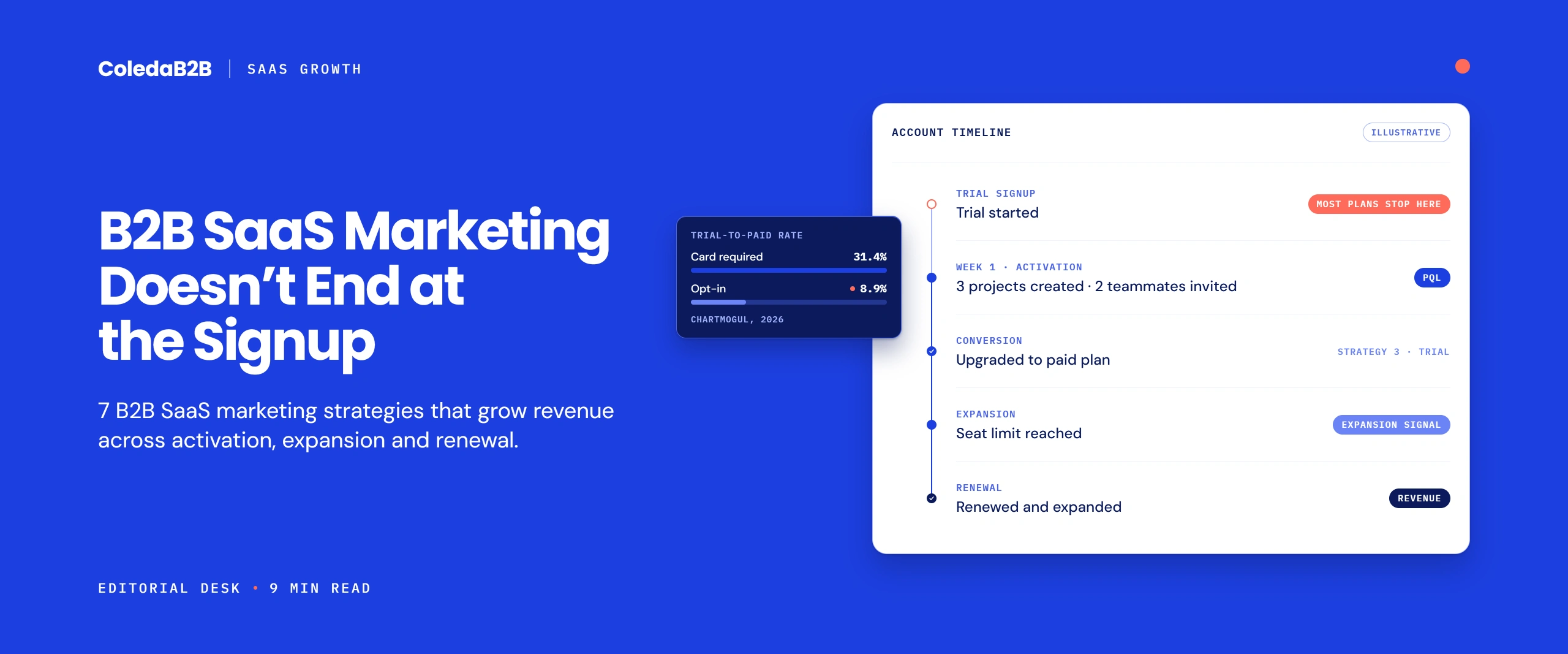
For example, take a project management tool. Its PQL might be a team that creates three projects and invites two colleagues in week one. That behavior predicts payment far better than a whitepaper download.
Also, score the account, not only the person. When three people from the same company sign up, that account deserves attention even if no single user looks hot.
Then keep nurturing the ones who aren’t ready. A trial that goes quiet on day five often just needs a nudge toward the next step, not a sales call. Our guide to MQLs explains how marketing-qualified leads fit alongside these product signals in SaaS lead scoring.
Common mistake: Sending every trial signup to sales on day one. Reps waste time on tire-kickers, while serious users lose momentum before they’ve seen any value.
3. Treat the Free Trial as Your Best Salesperson
Your trial does more selling than any rep. So its design deserves as much thought as your pricing page.
Trial model changes the numbers dramatically. A 2026 ChartMogul study of 200 products found opt-in trials converting at 8.9%. However, trials that required a credit card converted at 31.4%. First Page Sage’s earlier benchmark put those rates at 18.2% and 48.8%.
Of course, card-required trials also attract fewer signups. So neither model wins by default. Instead, choose based on how quickly a new user can see value.
That speed is the real lever. If users reach their first win in the first session, almost any trial model can work. But if setup takes a week, even a great product struggles.
So map the shortest path to that first win, then remove every step that doesn’t lead there. For example, pre-load sample data, skip optional settings, and send emails that point to the next action.
Common mistake: Measuring trial success by signups alone. A trial that brings in lots of users but few activated accounts just makes your funnel look busy.
4. Spend on Paid Growth Only Where the Payback Works
Paid ads still work in SaaS. However, they work best as an accelerator for demand that already exists, not as a replacement for it.
Before scaling any channel, check its CAC payback, not just its cost per lead. A cheap lead that never converts costs more than an expensive one that does.
Also, match the channel to buying intent. For example, search ads capture people already looking for a solution. LinkedIn ads work better for reaching specific roles and accounts before they start searching. Meanwhile, review site ads on G2 or Capterra reach buyers who are actively comparing.
Then retarget trial users who stalled, because they already know you and just need a reason to come back.
Common mistake: Judging paid campaigns on MQL volume. Since SaaS revenue compounds over time, a campaign’s real value only shows up in retention and expansion.
5. Build a Community That Does Real Work
Many SaaS communities start with energy and end as a quiet Slack channel. That usually happens when the community exists for the company, not for the members.
So give members a reason to show up that has nothing to do with your product pitch. For example, host peer sessions where customers share how they solved a problem. Also, publish templates, benchmarks, and playbooks that members help create.
When SaaS community building works, it does three jobs at once. First, it answers support questions before tickets pile up. Second, it gives product teams direct feedback. Finally, it turns happy users into advocates on review sites, in AI answers, and in peer recommendations.
Start small, though. Ten active members who help each other beat a thousand silent ones.
Common mistake: Launching a community without someone to run it. Without a dedicated owner, even a promising group goes quiet within months.
6. Market to Customers as Hard as You Market to Prospects
Remember the math: expansion costs about half as much as winning a new customer. But most B2B SaaS marketing budgets still go almost entirely to acquisition.
So treat your customer base as a segment with its own campaigns. For example, send feature updates by role, run “advanced use” webinars, and share stories from similar customers.
Also, watch usage data for expansion signals. When a team hits its seat limit or starts using a feature from a higher plan, that’s your moment to reach out.
Then work with customer success on renewal risk. If an account’s usage drops, a well-timed case study or training invite can do more than a discount.
Common mistake: Sending customers the same nurture emails you send prospects. Nothing says “we don’t know you” faster than a “book a demo” email to someone already paying.
7. Plan Distribution Before You Write Anything
Most B2B SaaS marketing teams create content first and figure out distribution later. As a result, good content often reaches almost nobody.
Instead, decide where each piece will live before anyone writes it. For example, one customer interview can become a case study, three LinkedIn posts, and a sales one-pager.
Also, remember that buyers now research inside AI tools like ChatGPT and Perplexity. So publish clear answers to the questions buyers ask, including comparison and pricing questions. Then check that review sites and partner pages describe you accurately. AI tools pull from all of them, not just your website.
We cover this shift in more depth in our guide to B2B digital marketing trends.
Common mistake: Writing for keywords only. When content doesn’t answer a real buyer question, neither search engines nor AI tools have a reason to surface it.
Which B2B SaaS Marketing Strategy Should You Start With?
You don’t need all seven at once. Instead, start with the symptom that hurts most right now.
| If this sounds familiar | Start with |
|---|---|
| Traffic is fine, but few people start a trial | Strategy 1: Problem-led demand |
| Lots of trials, very few paying customers | Strategy 3: Trial experience |
| Sales keeps complaining about lead quality | Strategy 2: Product-based scoring |
| CAC keeps rising every quarter | Strategy 4: Payback-based paid spend |
| Churn quietly erases new growth | Strategies 5 and 6: Community and customer marketing |
| Great content, but nobody sees it | Strategy 7: Distribution first |
The B2B SaaS Marketing Metrics That Actually Matter
MQL counts and traffic tell you very little about SaaS growth on their own. So track these instead, and review them with finance and customer success, not just marketing.
| Metric | What it tells you | Benchmark to compare against |
|---|---|---|
| CAC payback | How fast you recover acquisition spend | Median 16 months, top quartile 6 or less |
| New customer CAC ratio | Cost to win $1 of new ARR | Median about $2.00 |
| Trial-to-paid rate | Whether your trial proves value | 8.9% opt-in, 31.4% card required |
| Activation rate | Share of trials that reach first value | Set your own baseline, then improve it |
| Net revenue retention | Growth from existing customers | Median about 101% |
| PQL-to-customer rate | Whether product signals predict revenue | Compare against your MQL-to-customer rate |
Benchmarks vary a lot by deal size and sales motion. So compare yourself to companies with a similar price point, not to the headline median.
Want a SaaS growth engine that lasts past the first invoice? Our B2B demand generation team builds programs around activation, retention, and pipeline, not just lead volume.
The Real Job of B2B SaaS Marketing
B2B SaaS marketing used to mean filling the top of the funnel. Now it means growing revenue across the entire customer lifecycle.
So create demand around real problems. Then let product behavior tell you who’s ready, and make your trial do the selling. After that, spend on paid only where the math works, and give customers a community worth joining.
Most importantly, keep marketing to people after they pay. Because in SaaS, the first invoice isn’t the finish line. It’s the starting line.
FAQs:
SaaS customers can cancel at every renewal, so marketing has to support activation, retention, and expansion, not just the first sale. Also, the user and the buyer are often different people, so you need to win both.
A product-qualified lead, or PQL, is a user or account that has reached a meaningful milestone inside your product. For example, they created a project or invited teammates. PQLs usually predict paying customers better than content downloads.
It depends on your trial model. A 2026 ChartMogul study found opt-in trials converting at 8.9% and credit card trials at 31.4%. So compare yourself against the model you use, not a single industry average.
Very important when you run it well. A strong community reduces support load, gives product teams direct feedback, and turns users into advocates. However, it needs a dedicated owner and a clear reason for members to show up.
Recent benchmarks put the median around 16 months, with top-quartile companies at six months or less. Longer payback can still work when net revenue retention is strong, because customers keep expanding over time.
Measure B2B SaaS marketing with CAC payback, new customer CAC ratio, trial-to-paid rate, activation rate, and net revenue retention. These connect marketing to revenue, while traffic and MQL counts only show activity.