A marketing director pulls up the quarterly SEO report. Rankings held steady. Organic traffic fell 30%.
Then she checks the demo form. Three new prospects wrote the same thing in the “How did you hear about us?” field: ChatGPT recommended you.
That gap between the report and the pipeline is the clearest picture of where B2B SEO trends stand today. Search still matters. But a growing share of your visibility now happens inside AI answers that never send a click.
The short answer: B2B SEO now has two jobs. Rank in search, and get cited accurately in AI answers. Clicks from top rankings are falling, buyers increasingly build shortlists in AI chat, and AI tools lean heavily on third-party sources. The winning approach pairs solid technical SEO with answer-first content, real expertise, and a strong presence beyond your own website.
Trend 1: Ranking and Clicking Have Separated
For years, a top ranking meant traffic. That link is weakening fast.
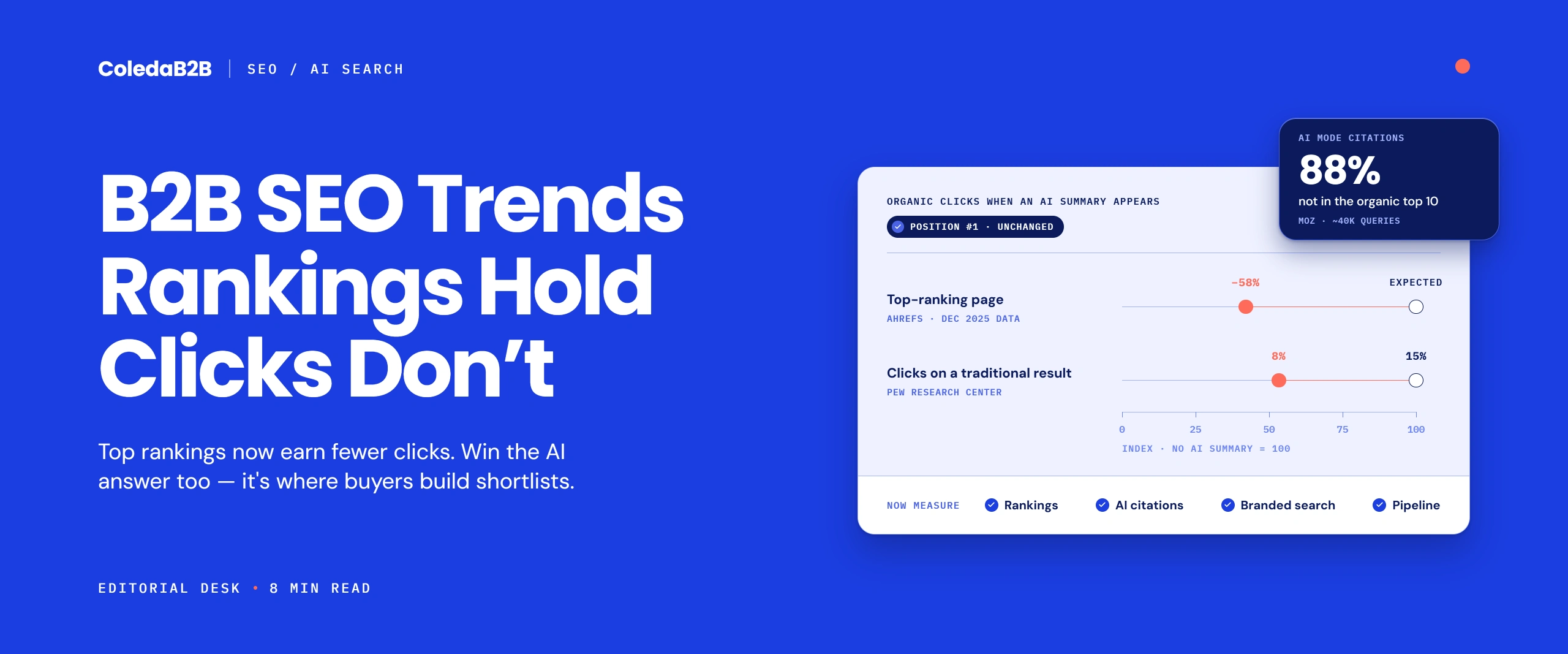
Ahrefs re-ran its click-through study using December 2025 data. It found that when an AI Overview appears, the top-ranking page gets about 58% fewer clicks than expected.
Pew Research Center saw the same pattern from the user side. People clicked a traditional result on 8% of visits when an AI summary appeared, versus 15% when it didn’t.
What it means: a falling traffic line doesn’t always mean failing SEO. Your answer may be reaching buyers on Google instead of on your site. So report impressions, AI citations, and branded search alongside sessions.
Trend 2: The Shortlist Now Forms Inside AI Chat
Many B2B buyers no longer start with a search box. G2’s 2025 Buyer Behavior Report found that AI chatbots were the single biggest influence on vendor shortlists, ahead of software review sites.
6sense’s 2025 Buyer Experience Report adds why this matters so much. The winning vendor is already on the buyer’s Day One shortlist 95% of the time.
What it means: if an AI tool leaves you out of its answer, you may never get a chance to compete. We cover this shift in depth in our guide to AI in B2B buying.
Trend 3: Your Off-Site Reputation Now Shapes Your Visibility
This is the shift most B2B teams underestimate. AI tools don’t just read your website. They read what others say about you.
Muck Rack’s ongoing What Is AI Reading? study found that earned media, such as journalism, research, and editorial coverage, makes up the large majority of non-paid AI citations. Its latest edition puts the figure at around 84%.
Moz found something similar inside Google itself. In a study of nearly 40,000 queries, 88% of AI Mode citations didn’t appear in the organic top 10 for the same query.
What it means: ranking your own page is no longer the whole job. Your presence on review sites, industry publications, and partner pages now feeds what AI says about you.
Trend 4: Proof Beats Polish
Google added Experience to its quality framework in December 2022, turning E-A-T into E-E-A-T. Since then, the bar has only risen.
The reason is simple. AI can now write a passable generic article in seconds. So search engines and AI tools lean on signals that are hard to fake:
- Named authors with real credentials
- First-hand examples from actual work
- Original data, benchmarks, or research
- A consistent reputation across trusted sources
For B2B companies, this is good news. Your practitioners, customer results, and deal experience are exactly the kind of proof generic content can’t copy.
Trend 5: Decision-Stage Pages Carry More Weight
AI tools answer comparison and evaluation questions with specific facts. If you don’t publish those facts, the AI pulls them from somewhere else, often a competitor or an outdated review.
So pages that used to feel optional now matter a great deal:
- Pricing ranges or clear pricing context
- Integration and compatibility lists
- Honest comparison pages
- Security and compliance summaries
- Case studies with real numbers
These pages help both search rankings and AI accuracy. They also give your sales team something to send when buyers ask.
What Hasn’t Changed at All
Not every one of today’s B2B SEO trends is new. In fact, the fundamentals matter more now, because AI systems build on the same crawled content as search engines.
| Fundamental | Why it still matters | Quick check |
|---|---|---|
| Crawlability | If crawlers can’t reach a page, neither search nor AI can use it | Sitemap is current, and robots.txt blocks nothing important |
| Content in the HTML | Many AI crawlers struggle with content loaded only by JavaScript | Key text appears when you view the page source |
| Page speed | Core Web Vitals still affect rankings, and INP replaced FID in March 2024 | Key templates pass in Search Console |
| Search intent | A page that matches no clear buyer stage still struggles | Each page targets one stage and one main question |
| Backlinks | Links remain a strong ranking signal | Earn links from relevant industry sites, not directories |
| AI crawler access | You can’t be cited if you’ve blocked the crawler | Your robots.txt matches your actual policy |
The Old Playbook vs the New One
| Old B2B SEO playbook | New B2B SEO playbook | |
|---|---|---|
| Main goal | Rank and earn the click | Rank, and get cited accurately in AI answers |
| Content style | Long intros, keyword-led | Answer first, then depth |
| Authority | Backlinks to your site | Backlinks plus mentions in trusted third-party sources |
| Measurement | Rankings and sessions | Rankings, AI citations, branded search, and pipeline |
| Priority pages | Top-of-funnel blog posts | Blog posts plus pricing, comparison, and proof pages |
| Owner | SEO team alone | SEO, content, PR, and product marketing together |
The last row is the real change. B2B SEO is no longer something one specialist can carry alone.
How to Act on These B2B SEO Trends: A 90-Day Plan
You don’t need a new team to start. You need a focused quarter.
| Month | Focus | What to do |
|---|---|---|
| Month 1 | Fix and baseline | Run a technical check on your top 20 pages. Build a fixed set of 20 to 30 buyer prompts and record how AI tools describe you today. |
| Month 2 | Rewrite and structure | Rewrite your top 20 pages so the main answer appears in the first two or three sentences. Add clear headings, comparison tables, FAQs, and schema markup. |
| Month 3 | Build beyond your site | Refresh review profiles, pitch data or expert commentary to industry publications, and place research on respected third-party sites. Then rerun your prompt set and compare. |
Write Answer-First
AI tools and featured snippets both pull short, direct answers. Here’s the difference in practice:
Before: “In today’s fast-moving business world, finance teams are always looking for new ways to improve efficiency.”
After: “Invoice automation software reads incoming invoices, matches them to purchase orders, and routes them for approval without manual entry. It suits finance teams handling hundreds of invoices a month.”
The first version gives an AI tool nothing to quote. The second answers the question, names the audience, and states a fact worth citing.
Structure Pages for Machines and People
Use descriptive headings, short paragraphs, tables for comparisons, and direct answers in FAQs. Also add schema markup for articles, FAQs, products, and your organization.
One note: Google now shows FAQ rich results for very few sites. Still, structured data helps machines read your page correctly, so it’s worth keeping.
Build Your Third-Party Footprint
Since AI leans so heavily on earned sources, off-site work now counts as SEO:
- Keep profiles on G2, Capterra, or TrustRadius active and recent.
- Offer data and expert commentary to industry publications.
- Place research on respected third-party sites through content syndication.
- Turn happy customers into visible voices with a customer advocacy program.
- Make sure partner and integration pages describe you accurately.
For help mapping content to each buyer stage, see our guide to B2B content marketing.
How to Measure AI Visibility
You can’t improve what you don’t track. So build a fixed prompt set and run it every month in ChatGPT, Gemini, Perplexity, and Google AI Mode.
| Prompt type | Example | What it tells you |
|---|---|---|
| Category | “Best [category] for [industry]” | Whether you make the shortlist |
| Comparison | “[Your brand] vs [competitor]” | How AI frames your differences |
| Problem | “How to reduce [problem]” | Whether you appear early in research |
| Pricing | “How much does [category] cost?” | Whether your pricing information is accurate |
| Reputation | “Is [your brand] good for [use case]?” | Which sources shape your reputation |
For each prompt, record three things: whether you appear, how you’re described, and which sources are cited. The cited sources become your outreach and syndication list.
Also, add an open-text “How did you hear about us?” field to your forms. It captures research your analytics can’t see, as we explain in our piece on the dark funnel. Pair it with branded search data in your B2B marketing analytics tools.
Score Yourself: A 10-Point B2B SEO Audit
Give each statement 2 points if it’s fully true, 1 if it’s partly true, and 0 if it’s not true yet.
| # | Statement | Score |
|---|---|---|
| 1 | Our top 20 pages answer the main question in the first two or three sentences. | |
| 2 | We check how AI tools describe us at least once a month. | |
| 3 | We appear on review sites, publications, and partner pages that AI tools cite. | |
| 4 | Every article has a named author with real credentials. | |
| 5 | Our key pages pass Core Web Vitals, including INP. | |
| 6 | Important content loads in the HTML, not only through JavaScript. | |
| 7 | Schema markup covers our articles, FAQs, products, and organization. | |
| 8 | We have content for the awareness, consideration, and decision stages. | |
| 9 | Our top pages get fresh data at least twice a year. | |
| 10 | Our reports include AI citations and branded search, not just traffic. |
- 16 to 20: You’re well placed for both search and AI. Scale what works.
- 10 to 15: The basics are solid, but there are real gaps. Fix your lowest scores first.
- Under 10: Start with technical fixes and answer-first rewrites of your top 20 pages.
Rerun this audit every quarter. B2B SEO trends will keep shifting, and the score shows you whether you’re keeping up.
The Bottom Line
The biggest B2B SEO trends point in one direction. Search is no longer only about where you rank. It’s about whether buyers, and the AI tools they trust, can find a clear, accurate, and well-supported answer about you.
Keep the fundamentals tight. Write answers, not introductions. And build a reputation beyond your website, because that’s increasingly where your visibility is decided.
Want your research cited where buyers and AI tools both look? ColedaB2B’s content syndication team places B2B content on respected third-party publications that buyers read and AI systems draw from. Talk to us about your content.
FAQs:
The biggest shift is visibility inside AI answers. Buyers increasingly use AI tools to research vendors and build shortlists, so being cited accurately in those answers now matters alongside traditional rankings.
Yes. AI tools build on the same crawled content as search engines, so technical SEO, clear structure, and strong content remain the foundation. Rankings also still drive valuable traffic, especially for decision-stage searches.
AI Overviews often answer the question directly on the results page. Ahrefs found that an AI Overview reduces clicks to the top-ranking page by about 58%, so traffic can fall even when rankings hold.
Write answer-first content with clear structure and specific facts. Then build your presence on review sites, industry publications, and partner pages, because AI tools draw heavily on earned, third-party sources.
E-E-A-T stands for Experience, Expertise, Authoritativeness, and Trustworthiness. Search engines and AI tools favor content from credible, experienced sources, which gives B2B companies with real practitioner knowledge an advantage.
Review your strategy every quarter and your technical setup twice a year. AI search features change every few months, but the fundamentals move much more slowly.