How do you choose an ABM agency or partner? Score every shortlisted option on the same weighted criteria: target account fit, data quality, execution model, sales alignment, reporting, and compliance. Then test each claim in the sales call with specific questions. As a result, you compare evidence instead of pitches, and the strongest partner becomes clear.
Definition: An ABM agency or partner is an outside team that plans and runs account-based programs for you, from building the target account list to reaching buying groups and handing engaged accounts to sales.
Why It Is Hard to Choose an ABM Agency
Most ABM pitches sound alike. Every partner promises personalization, buying group reach, and sales alignment. However, the real differences sit underneath: who does the work, where the data comes from, and what happens when an account does not respond.
Meanwhile, the stakes are high. In Momentum ITSMA’s ABM benchmarking study of 279 ABM leaders, companies said 28% of their marketing budget went to ABM. Yet only 17% of programs had become a core part of go-to-market strategy.
In other words, ABM takes a large share of budget, and most programs are still maturing. So the partner you pick shapes results for a long time. That is why knowing how to choose an ABM agency matters as much as the program itself.
Agency, Vendor, or In-House: What Are You Actually Buying?
Before you compare partners, be clear on the category. Buyers often mix up three very different options.
| Option | What you get | Best when | Main limitation |
| ABM agency or partner | A team that plans and runs programs: list building, content, outreach, media, and reporting | You need execution capacity and do not have a full ABM team. | Quality depends heavily on who does the work. |
| ABM vendor (software platform) | Tools for intent data, account scoring, ads, and orchestration | You already have people to run programs. | The platform does not run the program for you |
| In-house team | Full control over strategy and messaging | You have a budget for several specialist hires. | Slow to build, and hard to scale quickly |
In practice, many teams end up with a mix. For example, a company may own the strategy in-house, use one platform and bring in a partner for execution. If you are comparing software, see our guide to ABM tools. This post focuses on choosing the team.
Three Decisions to Make Before You Shortlist
A scorecard only works when you know what you need. So before you decide how to choose an ABM agency, settle these three points internally first.
1. Which ABM tier are you running? One-to-one programs for a few strategic accounts need deep research and custom content. One-to-many programs for hundreds of accounts need data, scale, and automation. A partner strong at one may be weak at the other.
2. What does success look like at 90 days and at 12 months? Early on, look for engaged accounts and meetings. Later, look for pipelines and won deals. Write both down, so every partner answers the same brief.
3. What will your sales team commit to? ABM fails when sales ignores engaged accounts. Agree on follow-up times and account owners before any partner starts.
If these are not settled yet, start with how to build your ABM strategy, then come back to selection.
The Scorecard: How to Choose an ABM Agency With Weighted Criteria
Now for the core of the method. Each criterion has a weight that reflects how much it affects results. Then, for each one, there is a question to ask in the sales call and a description of a strong answer.
| Criterion | Weight | What to ask in the sales call | What a strong answer sounds like |
| Target account fit | 15% | “How would you build and check our target account list?” | They ask about your best customers, lost deals, and sales capacity before naming a number. |
| Data source and quality | 15% | “Where do your contacts and intent signals come from, and how often are they checked?” | Named sources, a clear refresh cycle, and a human check before delivery |
| Execution model | 15% | “Who will actually run our program day to day? Is any work subcontracted?” | Named roles, an in-house team, and one point of contact |
| Buying group reach | 15% | “How do you reach the different roles in one account?” | Role-based messages and channels for each persona, not one email to everyone |
| Sales alignment | 10% | “What happens when an account starts engaging?” | A clear handover rule, alert format, and follow-up time were agreed upon with sales. |
| Reporting and measurement | 10% | “Show me a sample report. What do you measure at 30, 90, and 180 days?” | Account-level engagement and pipeline, not just clicks and leads |
| Compliance and data protection | 10% | “How do you handle consent and opt-outs in the US, UK, and EU?” | Documented processes, named regulations, and certifications they can show |
| Commercial terms | 10% | “What is included, what costs extra, and what is the minimum term?” | A written scope, clear inclusions, and a fair exit clause |
How to score each partner
First, rate every criterion from 1 to 5 for each partner, based on their answers. Then multiply each rating by its weight, and add the results. The highest total wins, as long as no criterion scored a 1.
That last rule matters, because a partner that scores high overall but fails on compliance or data quality is still a risk.
A Worked Example: Two Partners, One Brief
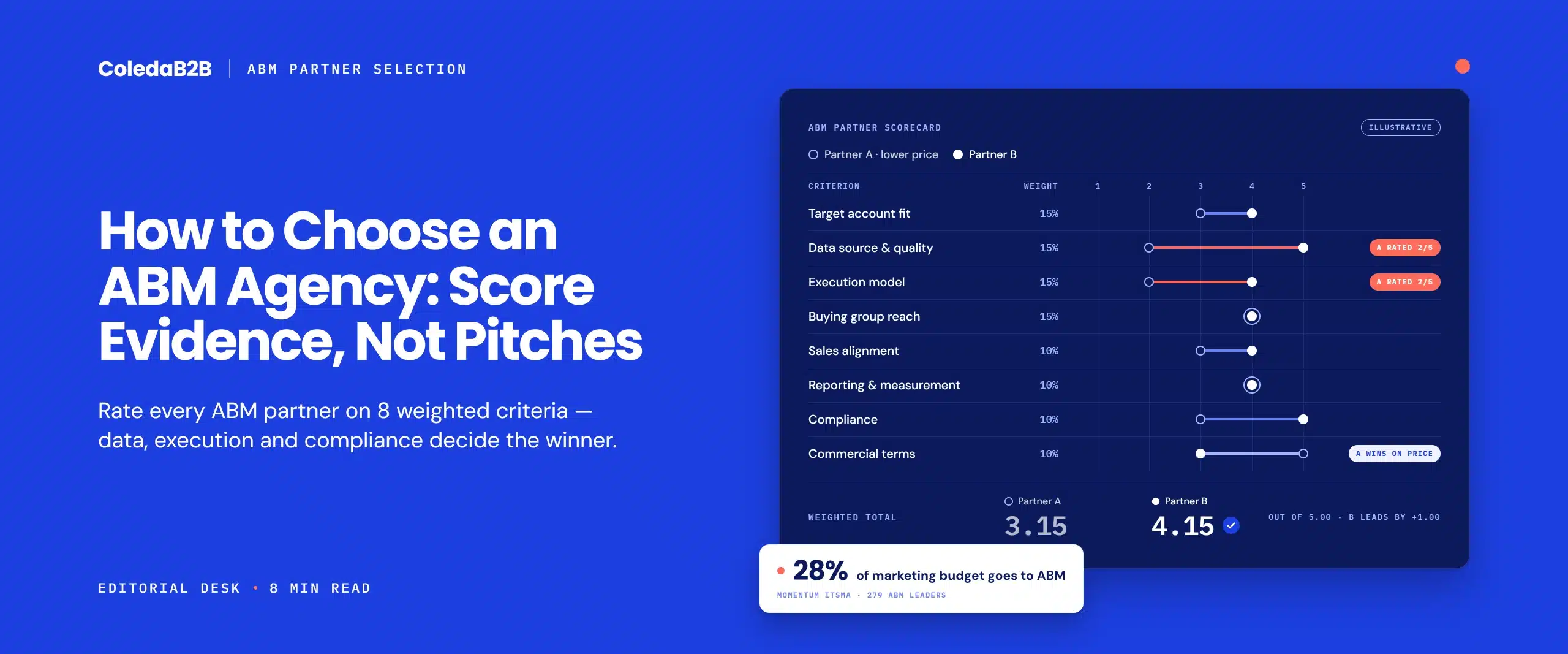
This illustrative example shows how the scorecard changes a decision. Partner A has the lower price and a polished pitch. By contrast, Partner B costs more but answered every question in detail.
| Criterion | Weight | Partner A: rating (weighted) | Partner B: rating (weighted) |
| Target account fit | 15% | 3 (0.45) | 4 (0.60) |
| Data source and quality | 15% | 2 (0.30) | 5 (0.75) |
| Execution model | 15% | 2 (0.30) | 4 (0.60) |
| Buying group reach | 15% | 4 (0.60) | 4 (0.60) |
| Sales alignment | 10% | 3 (0.30) | 4 (0.40) |
| Reporting and measurement | 10% | 4 (0.40) | 4 (0.40) |
| Compliance and data protection | 10% | 3 (0.30) | 5 (0.50) |
| Commercial terms | 10% | 5 (0.50) | 3 (0.30) |
| Total weighted score | 100% | 3.15 | 4.15 |
Partner A won on price. However, it lost on data and execution, which drive most of the results. In practice, this pattern is common: the cheaper pitch often hides subcontracted work or recycled lists.
Red Flags to Spot When You Choose an ABM Agency
Some answers should end the conversation. Watch for these during the sales call.
- A target list size before any questions. If they quote “500 accounts” before asking about your customers, they are selling a package.
- “Our proprietary database” with no detail. Ask where the data comes from and when it was last checked. A vague answer usually means bought lists.
- No names for the delivery team. If nobody can tell you who will run the work, someone else is likely doing it.
- Lead counts as the main success metric. After all, you measure ABM at account level. A partner focused on lead volume is running demand gen under a new name.
- No sample report. Ask to see a real (anonymized) report. If they cannot show one, they may not measure what matters.
- Silence on compliance. If consent, opt-outs, and regional rules are not part of the answer, they are part of your risk.
MarTech also offers a longer list of questions for ABM vendors, which is useful if you are assessing software alongside a partner.
What a Good ABM Proposal Includes
Once you have a shortlist, the next step in how to choose an ABM agency is the proposal. Ask each partner for a written proposal against the same brief. A strong proposal answers these points clearly:
- Target account approach: how the list is built, checked, and refreshed
- Buying group map: which roles they will reach in each account and how
- Channel plan: which channels run for each tier and in what order
- Content plan: what they will create, what they need from you, and who approves it
- Handover rules: when an account goes to sales, and in what format
- Reporting: what you will see, how often, and at which stages
- Team and roles: named people, their responsibilities, and their hours
- Compliance: how consent, opt-outs, and data storage work in each region
- Commercial terms: pricing model, inclusions, extras, term, and exit
If a proposal leaves out handover rules or reporting, ask for them before signing. Those two areas cause most ABM disputes later.
Pricing: What to Compare When You Choose an ABM Agency
In short, there is no standard price for ABM, because scope varies so much. Still, most partners use one of four models.
| Pricing model | How it works | Works best for | Watch for |
| Monthly retainer | A fixed monthly fee for an agreed scope | Ongoing programs with steady work | Scope creep with no clear limits |
| Program or project fee | A fixed fee for a defined program, such as one quarter | Pilots and one-to-few programs | Extra charges once the program ends |
| Per-account pricing | A fee per target account in the program | One-to-one and one-to-few tiers | Pressure to add accounts you do not need |
| Performance-linked | Part of the fee tied to meetings or engaged accounts | Teams that want shared risk | Loose definitions of “engaged” or “meeting” |
Whichever model you choose, get the definitions in writing. Above all, agree what counts as an engaged account or a qualified meeting before the program starts.
How ColedaB2B Approaches ABM
As a partner, we run account-based marketing with a fully in-house team, with no subcontracting. Each client gets a dedicated team, so the people in the sales call are connected to the people doing the work.
We also use intent signals from our own network of seven B2B publishers. As a result, we can see which of your target accounts are reading about related topics before outreach starts. We are also ISO certified and GDPR and CCPA compliant, and we never qualify a lead without an opt-in.
If you are still working out how to choose an ABM agency, use the scorecard above on us too. We would rather earn the score than ask for the benefit of the doubt.
Shortlisting ABM partners now? Share your target account list, and we will show which accounts are engaging with related content across our network, plus how we would reach each buying group.
Get a target account engagement plan
FAQs:
An ABM agency plans and runs account-based programs for you. That usually covers target account selection, buying group research, content, outreach across several channels, and reporting on account engagement and pipeline.
An ABM vendor sells software, such as intent data, account scoring or ad tools. An ABM agency provides people who run the programs. Many teams use both: a platform for data and a partner for execution.
Most use a monthly retainer, a fixed program fee, per-account pricing or a performance-linked model. Price depends on the number of accounts, the ABM tier and the channels used. Always get inclusions and definitions in writing.
It should cover the target account approach, buying group map, channel and content plan, handover rules for sales, reporting, named team roles, compliance and commercial terms. Missing handover rules or reporting are warning signs.
Ask who will run the program day to day, where the data comes from and what happens when an account engages. Vague answers, unnamed teams and a focus on lead volume usually point to weak execution.