AI lead generation works best as a speed tool for research, data work, and first drafts, with people checking accuracy, fit, and tone before anything reaches a buyer. It works best as a replacement for judgment. By contrast, teams that let AI choose targets and send messages unchecked tend to get more activity, more errors and fewer real conversations.
Definition: AI lead generation is the use of artificial intelligence, including machine learning models, large language models, and AI agents, to find, research, score, and contact potential B2B buyers, usually alongside human sales and marketing teams.
Updated November 2026
AI Lead Generation in 2026: What the Research Says
Adoption has moved fast. However, results have not kept pace. Three recent findings set the scene.
- Agent use has doubled. The Content Marketing Institute’s 2026 B2B research, published on 4 November 2026 from a survey of 861 B2B marketers, found 59% use or test AI agents, up from 28% a year earlier.
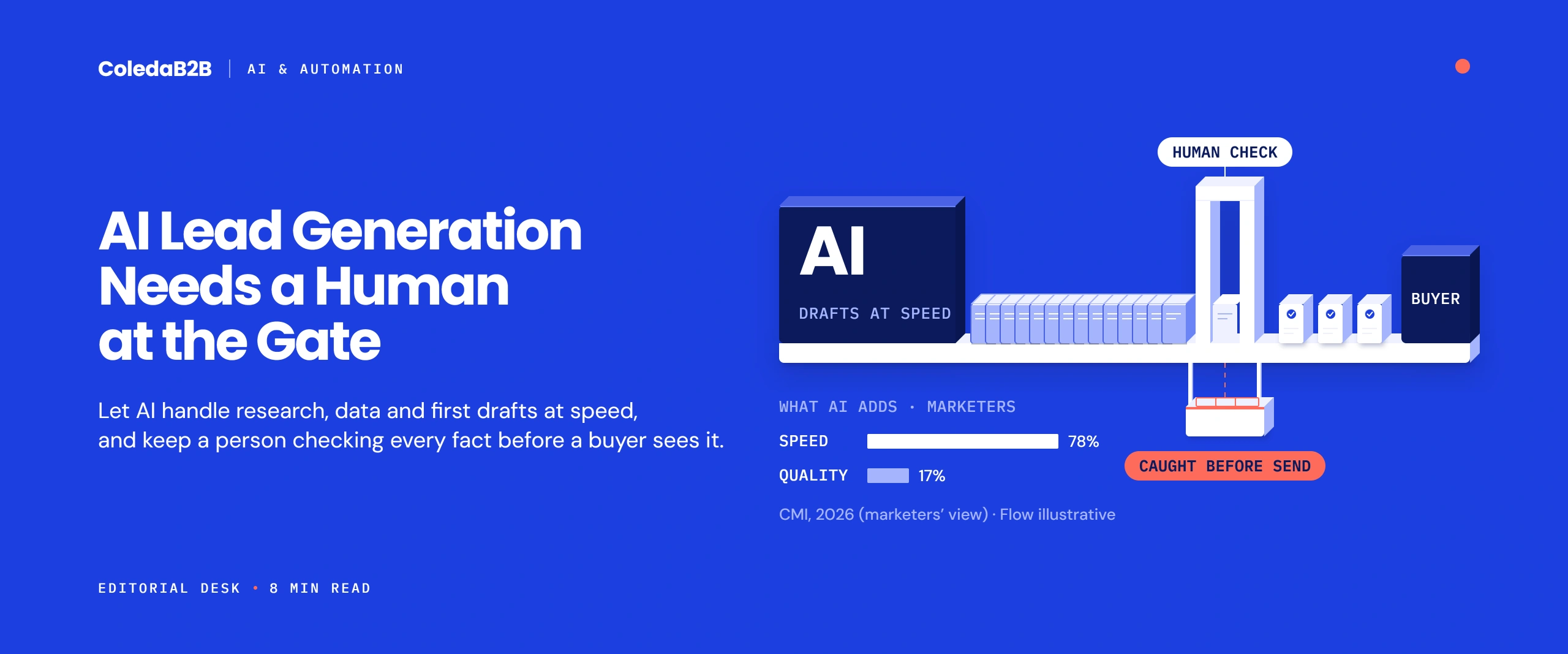
- Speed beats quality. In the same survey, marketers named speed (78%) and efficiency (59%) as AI’s main contributions. By contrast, only 17% named quality, while accuracy (54%) topped the list of AI challenges.
- More agents do not mean more output. Gartner, reported by CRM Magazine in September 2026, predicts AI agents will outnumber sellers 10 to one by 2028. However, it also expects fewer than 40% of sellers to say those agents improved their productivity.
In short, nearly every team is now using AI. As a result, the difference lies in how carefully they use it.
Five Myths About AI Lead Generation
Myth 1: AI can generate leads on its own.
In reality, AI can find and draft. Yet it cannot confirm that a person has a real need, budget, or timeline. Therefore, a lead still needs a human to qualify it, and a buyer still needs a reason to reply.
Myth 2: More AI-written emails mean more pipeline.
After all, volume without relevance damages sender reputation and annoys buyers. CMI found 75% of marketers worry AI is making audiences more skeptical of online content. So, sending more of the same message makes that problem worse.
Myth 3: Automated data is accurate data.
For example, AI tools often merge sources that disagree, and language models can state wrong facts with confidence. So treat every job title, company detail, and “trigger” an AI tool finds as a lead to check, not a fact.
Myth 4: AI SDRs will replace human SDRs.
AI SDR tools can handle research and first drafts. Still, complex B2B deals involve several people, long cycles, and real objections. In practice, most teams get better results when AI supports SDRs rather than replacing them.
Myth 5: Compliance is the vendor’s problem.
If you use an AI tool to process personal data or contact people, you stay responsible for how that data is used. In other words, buying a tool does not transfer the legal duty.
Where AI for Lead Generation Earns Its Place
The table below breaks AI for lead generation into five common tasks. For each, it shows what AI does well, what a person must still check, and what goes wrong without that check.
| Task | What AI does well | A human check is needed. | Risk if unchecked |
| Account research | Summarizes news, filings, job posts, and websites in minutes | Confirm facts and dates against the source. | Outreach based on old or invented facts |
| Contact discovery and enrichment | Fills missing titles, departments, and company details at scale | Verify the person still holds the role; check consent status. | Wrong people, bounces, compliance gaps |
| Lead scoring | Spot patterns across engagement, firmographic, and intent data | Review scores against closed deals every quarter | Scores that reward activity, not buying signals |
| Personalized first drafts | Writes variants by role, industry, and trigger | Edit for accuracy, tone, and one clear ask. | Generic or wrong claims sent under your name |
| Reply sorting and follow-up | Sorts replies by intent and drafts responses | Read every positive or unclear reply before responding. | Missed buyers or awkward automated answers |
For more on the data side, see B2B data enrichment.
The Work That Still Needs a Human
However, some parts of lead generation depend on judgment that AI cannot yet provide reliably.
- Choosing who to target. Deciding which segments and accounts deserve effort is a strategy call, linked to your product, pricing, and wins.
- Qualifying need. Only a conversation confirms whether a problem is real and urgent.
- Handling objections. Buyers raise concerns that depend on context, politics, and timing.
- Building trust. Senior buyers often want to talk to a person who understands their situation.
- Deciding what not to send. Sometimes the right move is to wait, whereas AI tools are built to act.
Meanwhile, the buyer side is changing too. Many buyers now research with AI before they contact anyone, so it helps to understand how buyers use AI to shortlist vendors.
AI SDRs: What They Can and Cannot Do
An AI SDR is software that researches prospects, writes outreach, and sends follow-ups with limited human input. To see the full role it tries to copy, it helps to know what an SDR does.
What AI SDRs do well: research at volume, first drafts, sequence timing, and sorting replies. What they struggle with: reading context, handling detailed questions, adjusting to a buying group, and knowing when to stop.
So a sensible model is “AI drafts, human sends” for priority accounts, with more automation allowed only for lower-value segments once results are proven.
AI Lead Generation Tools by Job
Rather than chasing a “best tools” list, group these tools by the job they do. Then pick one per job and test it properly.
1. Research assistants summarize companies, news, and people before outreach.
2. Data and enrichment tools fill and update contact and account records.
3. Intent and scoring tools rank accounts and leads by signals of interest.
4. Writing assistants draft emails, LinkedIn messages, and call notes.
5. Sequencing tools with AI features to time and send outreach and sort replies.
6. Website chat and AI agents answer visitor questions and book meetings. To compare options, see how to choose an AI chatbot.
Also, before signing any contract, ask each vendor where its data comes from, how it handles personal data, and how you can review its output before it reaches a buyer.
A Risk Register for AI Lead Generation
Write these risks down before the first automated send, and name an owner for each control.
| Risk | What goes wrong? | Control |
| Inaccurate data | Wrong names, titles, or facts in outreach | Verify contacts before sending; spot-check AI research weekly. |
| Transparency rules | Buyers are not told they are talking to AI. | Label AI chat and agents clearly; follow the EU AI Act rules below. |
| Personal data use | Data collected or used without a lawful basis | Record sources and lawful basis; follow GDPR, UK GDPR, and CCPA. |
| Brand damage | Off-tone or false claims sent at scale | Human review for priority accounts; approved claim library |
| Hidden bias | Scoring favors past patterns and ignores new markets. | Review scores against closed deals and new segments |
| False success | Activity rises while meetings and the pipeline do not. | Measure meetings, opportunities, and pipeline, not sends. |
On compliance: the EU AI Act’s Article 50 transparency rules have applied since 2 August 2026. According to Goodwin’s August 2026 summary, providers must tell people when they are interacting with an AI system, unless it is obvious. In addition, AI-generated content needs a machine-readable mark. Providers of generative systems already on the market before that date have until 2 December 2026 to meet the marking duty. Meanwhile, in the UK, the ICO’s guidance on AI and data protection is a useful reference. Also, CMI found 52% of organizations have no AI disclosure policy, so writing one is a quick win. This is guidance, not legal advice.
How to Start AI Lead Generation in 30 Days
Week 1: Pick one problem. Choose a single slow task, such as account research for one segment. Then record how long it takes today and what good output looks like.
Week 2: Test one tool. Run it on 50 to 100 accounts. Next, have a person check every output and note the error rate.
Week 3: Set the rules. First, write down what AI may do alone, what needs review, and what it must never do. Then add your disclosure wording and data rules.
Week 4: Compare results. Measure time saved, accuracy, reply rate, and meetings against a group handled without AI. Finally, expand only if quality held up.
How to Measure AI Lead Generation
Time saved is the easiest number to report and the least useful on its own. Instead, track a short set of outcome measures:
- Accuracy rate: share of AI research and data that passes human checks
- Positive reply rate: replies showing interest, not just any reply
- Meetings held per 100 accounts: compared with your non-AI baseline
- Opportunity and pipeline value from AI-supported programmes
- Complaint and unsubscribe rates: an early warning of volume without relevance
Similarly, Gartner’s advice runs the same way: measure how AI expands seller capacity and effectiveness, not just the hours it saves.
How ColedaB2B Combines Automation With Human Checks
As a partner offering B2B lead generation services, we use automation where it is reliable and people where judgement matters. Every lead goes through a three-step check that pairs automated validation with human review, drawn from our database of 50M+ B2B contacts and seven owned publishers. Moreover, our team is fully in-house, with no subcontracting, and our programmes follow GDPR and CCPA and use opt-in data.
Want AI speed without losing lead quality? Tell us your targets, and we will show you where automation fits in your programme and where a person should stay in charge.
FAQs:
Not reliably. AI can research accounts, enrich contact data and draft outreach at speed, but it cannot confirm a buyer’s need, budget or timing. Most B2B teams get better results when AI handles the volume work and people check accuracy, qualify interest and run the conversations.
The strongest uses are account research, data enrichment, lead scoring, first drafts of personalised outreach and sorting replies. Each saves time, but each still needs a human check, especially for facts, job titles and anything sent to priority accounts under your company’s name.
Not in most B2B sales. AI SDR tools handle research, drafts and follow-up timing well, but complex deals involve buying groups, objections and long cycles. Gartner expects fewer than 40% of sellers to say AI agents improved their productivity by 2028, which suggests support works better than replacement.
It can be, but compliance depends on how you use it. You still need a lawful basis for personal data, clear records of where data came from and respect for objections. In the EU, AI Act Article 50 also requires telling people when they are interacting with AI. Check your setup with counsel.
Measure outcomes, not activity. Track the accuracy of AI research and data, positive reply rate, meetings held per 100 accounts and pipeline from AI-supported programmes, compared with a group handled without AI. Watch complaint and unsubscribe rates as an early warning sign.