How do you build a content syndication strategy? Start with the pipeline goal, choose one strong asset, define the exact audience and lead filters, agree how leads will be validated, and plan sales follow-up before launch. Written down, those six decisions make every delivered lead one your team can actually act on.
Definition: A content syndication strategy is the plan that sets the goal, asset, audience, lead filters, validation rules, and follow-up for a program that places your content on third-party sites and email lists.
Why Syndication Programs Need a Plan First
Most syndication programs that disappoint were not short of leads. They were short of decisions. The asset was picked because it existed, the filters were loose, and nobody agreed what sales would do with a lead that downloaded a report on a Tuesday.
The case for syndication is still strong. Buyers do much of their research alone: a 2025 Gartner survey found that 61% of B2B buyers prefer a buying experience without a sales rep. Putting useful content where they already read is one of the few ways to reach them early.
The six steps below turn that reach into leads your team can use.
The Six-Step Content Syndication Strategy
Step 1: Set the Goal
Decide what the program must produce and what happens to it next. “More leads” is not a goal.
- Decide: the lead type (CQLs for nurture or leads with extra qualifying questions for faster sales follow-up), the volume, and the outcome you will judge it on, such as meetings or opportunities.
- Watch out for volume targets your team cannot follow up on. Set the number from your nurture and SDR capacity, not from the budget alone.
Step 2: Choose the Asset
The asset does the selling on someone else’s website. Buyers see a title, a short summary, and a cover, then decide in seconds.
- Decide: one asset per program that answers a question your buyers are already asking. Research reports, practical guides, checklists, and benchmark data work best.
- Watch out for product brochures and thin e-books. If the asset only describes your product, the people who download it are rarely the ones you want.
Step 3: Define the Audience
This is where a content syndication strategy is won or lost. Describe the audience in terms a vendor can actually filter on.
- Decide: industries, company size, regions, job functions, and seniority. If you run ABM, add your target account list.
- Plan for the whole buying group. Forrester’s State of Business Buying 2024 found that, on average, 13 people are involved in a purchase decision. Reach several roles in each account, not only the most senior title.
- Watch out for: a persona list that is too narrow to deliver. If only a few hundred people match, the program will deliver too few leads, or the filters will quietly loosen to make up the number.
Step 4: Set the Lead Filters
Filters decide which downloads count as leads. Write them down as include and exclude rules.
- Decide on job titles to include and exclude, the company size range, regions, any required technology, and one or two custom questions such as project timing.
- Add the protective rules: a cap on leads per company, a suppression list of existing customers and open opportunities, and exclusions for competitors and students.
- Watch out for: too many custom questions. Each one lowers completion. Keep to the questions sales will actually use.
Step 5: Agree on the Validation Rules
Validation is what separates a lead from a form fill. Agree on it in writing before launch.
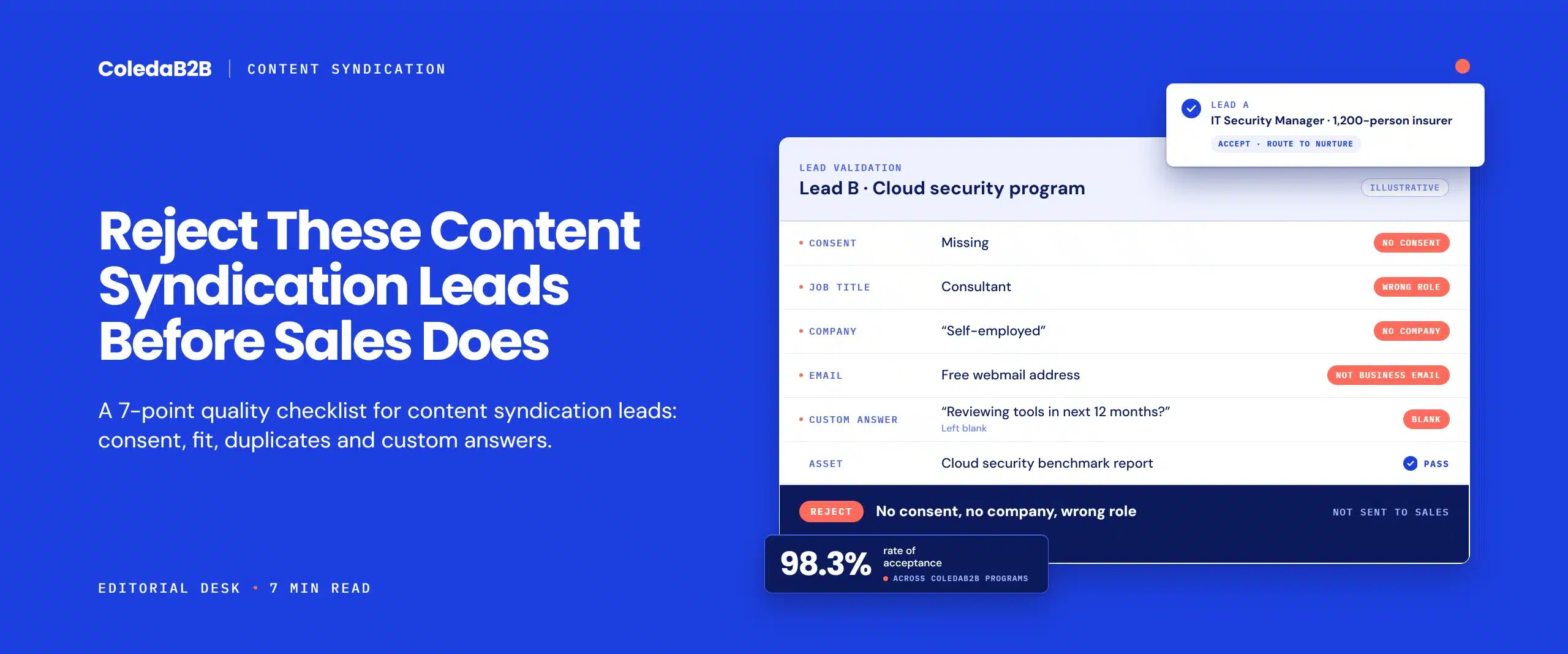
- Decide: which checks happen before delivery: consent recorded, email and phone verified, job title and company confirmed, duplicates removed, and filter rules applied.
- Agree on the rejection rules: what counts as a valid reason to reject a lead and how long you have to flag it.
- Watch out for: checks that exist only in a sales deck. Ask to see how a lead is checked and by whom.
Step 6: Plan the Follow-Up
A CQL is an early-stage lead. Without a plan for the next touch, it goes cold before anyone calls.
- Decide: how leads are routed into your CRM, which nurture sequence they enter, when SDRs reach out, and what the first message says. The first message should mention the asset the person downloaded.
- Set a feedback loop: a weekly review with the vendor of accepted and rejected leads so filters can be adjusted mid-program.
- Watch out for: leads that sit in a spreadsheet for two weeks. The person has forgotten the download by then.
The Content Syndication Planning Worksheet
Copy this table into a shared document before your next program. Fill in every row, and get both marketing and sales to sign it. The example entries are illustrative, for a security software vendor.
| Planning field | What to decide | Example entry | Owner |
| Program goal | Lead type, volume, and the outcome used to measure success | 400 CQLs for nurture; measured by meetings booked | Demand gen lead |
| Asset | One asset that answers a current buyer question | 2026 cloud security benchmark report | Content lead |
| Industries | Which sectors are in scope? | Financial services, healthcare, retail | Demand gen lead with sales |
| Company size | Employee or revenue range | 500 to 10,000 employees | Demand gen lead with sales |
| Regions | Countries or regions in scope | US, UK, Singapore | Demand gen lead |
| Job titles and seniority | Titles to include and exclude | Include: CISO, IT security manager, CIO. Exclude: students, consultants | Demand gen lead with sales |
| Custom questions | One or two questions sales will use | “Are you reviewing cloud security tools in the next 12 months?” | SDR manager |
| Protective rules | Leads per company, suppression, and exclusions | Up to 3 leads per company; suppress customers and open deals | Marketing ops |
| Validation and rejection | Checks before delivery and the rejection window | Consent, email, title, and company checked; rejections flagged within 10 days | Marketing ops with vendor |
| Routing and follow-up | CRM routing, nurture track, and first SDR touch | Into the security nurture track; SDR call after the second nurture email | SDR manager |
| Reporting | What gets reviewed and how often | Weekly accepted and rejected leads; monthly meetings and opportunities | Demand gen lead |
If a row is blank on launch day, the program is not ready.
What This Looks Like in a Real Program
A plan matters most at scale. Our program for Wolters Kluwer worked across 22,676 contacts and delivered 1,000 CQLs.
Two parts of the strategy mattered most. Distribution ran through our own B2B publishers, so content reached readers on sites we operate rather than through rented lists. And every lead passed a three-step quality check that combines RPA automation with human review before it reached the client.
How Do You Judge a Content Syndication Program?
Cost per lead is the easiest number to report and the least useful on its own. A strong content syndication strategy is judged further down the funnel:
- Acceptance rate: the share of delivered leads that pass your own checks.
- CQL to MQL rate: how many leads engage further in nurture.
- Meetings and opportunities: how many leads, or accounts, reach a sales conversation.
- Account coverage: how many target accounts now have more than one engaged person.
- Cost per opportunity: total program cost divided by opportunities created.
For the lead-level checks, see our guide on how to judge each syndicated lead. If you are still comparing vendors, our guide to choosing a content syndication platform covers what to ask.
How ColedaB2B Runs Syndication Programs
As a partner, we run B2B content syndication through our own network of B2B publishers, including TechsterHub, MarTechSpace, SalesTechSpace, and HRsTechSpace. No lead is qualified without an opt-in, and every lead goes through our three-step RPA and human quality check before delivery. Every content syndication strategy we run starts from a plan like the worksheet above, agreed with your team before launch, and we adjust filters weekly from your feedback.
Content syndication for B2B works when the plan comes before the media buy. We can help you build that plan.
Share your asset and target audience, and we will map where it can run across our publishers, which filters to apply, and what a realistic program looks like.
FAQs:
Research reports, practical guides, checklists, and benchmark data that answer a question your buyers already ask. Product brochures and thin ebooks rarely attract the right people.
A content-qualified lead (CQL) is a person who downloaded your syndicated content with consent and matches the agreed filters, such as job title, company size, and region. It is an early-stage lead that needs nurture before a sales call.
Set include and exclude rules for job title, seniority, industry, company size, and region, then add one or two custom questions. Suppress existing customers and cap the number of leads per company.
Review asset performance every month and replace an asset when the response drops or its data goes out of date. Many teams plan a new or updated asset each quarter so the same audience does not keep seeing the same title.
Contact and company details, the asset downloaded, the date and source, the consent record, answers to any custom questions, and the validation checks applied to that lead.