MQL vs SQL comes down to who has checked the lead and what they checked. An MQL is a lead marketing has judged ready for sales, based on fit and engagement. An SQL is a lead sales has spoken to and confirmed has a real need, the authority to act, and a reason to buy soon.
Definition: An MQL (marketing qualified lead) has shown enough fit and interest for marketing to pass it on. An SQL (sales-qualified lead) has been confirmed by sales as a real buying opportunity worth working on.
The gap between those two sign-offs is where most of the pipeline goes missing. Below you will find a side-by-side comparison, the stages in between, two worked lead journeys, and a checklist to use before any lead moves from marketing to sales.
MQL vs SQL at a Glance
Most arguments about lead quality start because the two teams use different words for different checks. This table puts the marketing-qualified lead vs. sales-qualified lead difference in one place.
| Area | MQL (Marketing Qualified Lead) | SQL (Sales Qualified Lead) |
| Who qualifies it? | Marketing, usually through lead scoring and data checks | Sales, usually an SDR or account executive, through a conversation |
| What it is judged on | Fit (industry, company size, job role, region) and engagement (downloads, visits, event attendance, email replies) | Confirmed need, buying authority or access to it, budget available or being planned, and a timeline |
| Evidence | Data and behavior | What the buyer said |
| Owner after qualification | Sales development, for follow-up | Account executive, for an opportunity |
| Next step | First sales contact within the agreed time | Discovery or demo meeting, then an opportunity in the CRM |
| If it fails | Goes back to marketing nurture | Goes back to nurture or is closed with a reason |
| What it tells you | This person may be worth a sales conversation. | This company may buy, and sales wants to pursue it. |
The simplest way to remember MQL vs. SQL: an MQL is a prediction, and an SQL is a confirmation.
Where MQLs and SQLs Sit in the Funnel
Whether your team says MQL vs SQL or SQL vs MQL, the two are stops on a longer path. Many teams still use a version of the SiriusDecisions demand waterfall, which adds a stage between them that is often skipped in conversation:
- Inquiry or CQL: Someone responds: fills a form, downloads an asset, or registers for an event. A content-qualified lead (CQL) is an inquiry from content syndication that already matches agreed filters such as job title and company size.
- MQL. Marketing scores the lead on fit and engagement and decides it is worth a sales call.
- SAL (sales accepted lead). Sales agrees the MQL is worth contacting and commits to follow up. Nothing is confirmed yet. It is a promise to act.
- SQL: Sales has spoken to the buyer and confirmed the need, authority, budget, and timing well enough to pursue.
- Opportunity. The deal is open in the CRM with a value and a stage.
The SAL step matters more than it looks. It is the point where sales says, “Yes, we will work this lead,” which ends most arguments about whether leads were ever followed up.
Fit and Interest: The Two Tests Behind an MQL
Before any lead becomes an MQL, it has to pass two separate tests. Teams that blend them into one score end up passing the wrong people to sales.
| Fit / Engagement | Low engagement | High engagement |
| High fit | Nurture: Right company and role, but not active yet. Keep them engaged. | MQL: Right profile and showing interest. Pass to sales. |
| Low fit | Remove or ignore: Wrong profile with no interest. | Not a buyer: Students, job seekers, competitors, and vendors often land here. Do not pass to sales. |
The bottom-right box is the one that hurts. These people download everything and attend every webinar, so a single combined score pushes them over the MQL line. Sales calls them, finds no buyer, and starts to distrust every MQL that follows. Keep fit and engagement as two scores, and require both.
For the full scoring criteria, see our guide on what makes a lead marketing qualified.
What Sales Checks to Turn an MQL Into an SQL
Marketing can only see behavior. Sales finds out the rest by asking. The SQL decision usually rests on four questions:
- Need: Is there a problem we solve, and does the buyer agree it is a problem?
- Authority: Is this person the decision-maker, or can they get us in front of one?
- Budget: Is money set aside, or is there a clear plan to find it?
- Timing: Is there a reason to act in a defined period, such as a contract renewal, a deadline, or a new project?
These are the BANT criteria. Most teams do not require all four on the first call. A common rule is a confirmed need plus at least two of the other three. Whatever rule you pick, write it down and get both teams to sign it. Our full SQL definition and qualification checklist covers the questions that confirm each one.
Two Lead Journeys, Start to Finish
Definitions are easier to apply with real shapes. Both journeys below are illustrative examples, not client results.
Journey 1: An MQL That Becomes an SQL
The buyer is an HR operations director at a 900-person logistics company. The seller offers workforce scheduling software.
| Step | What happened? | Stage |
| 1 | Downloads a guide on reducing overtime costs through a content syndication program | Inquiry (CQL) |
| 2 | Opens two nurture emails and visits the pricing page | Engagement rises. |
| 3 | Scores high on fit (right industry, company size, and role) and engagement | MQL |
| 4 | SDR accepts the lead and calls within the agreed time. | SAL |
| 5 | On the call, the director confirms that overtime costs are a board-level priority, owns the budget line, and says the current contract ends next quarter. | SQL |
| 6 | Demo booked with the director and finance lead | Opportunity |
What made it work: the fit was checked before the call, and the call confirmed need, authority, and timing in one conversation.
Journey 2: An MQL That Goes Back to Nurture
The buyer is an IT analyst at a 3,000-person retailer. The seller offers cloud cost management software.
| Step | What happened? | Stage |
| 1 | Attends a webinar on cloud cost control | Inquiry |
| 2 | Downloads two reports and clicks three emails | Engagement rises. |
| 3 | The company fits well, the job role is a partial fit, and engagement is high. | MQL |
| 4 | SDR accepts the lead and calls | SAL |
| 5 | On the call, the analyst explains they are researching for an internal report. There is no project, budget, or owner yet. | Not an SQL |
| 6 | Lead returns to nurture with the note: “Researching. Check again when a project is approved.” | Back to nurture |
This is not a failure. The MQL was reasonable, the call was quick, and the note gives sales a reason to come back. The real failure would be leaving the lead in an “MQL” status for months with no outcome recorded.
The MQL to SQL Handoff Checklist
This is where the MQL vs SQL line gets crossed in practice. Run these checks before any lead moves from marketing to sales. If one fails, the lead is not ready.
- Fit score and engagement score both meet the agreed threshold.
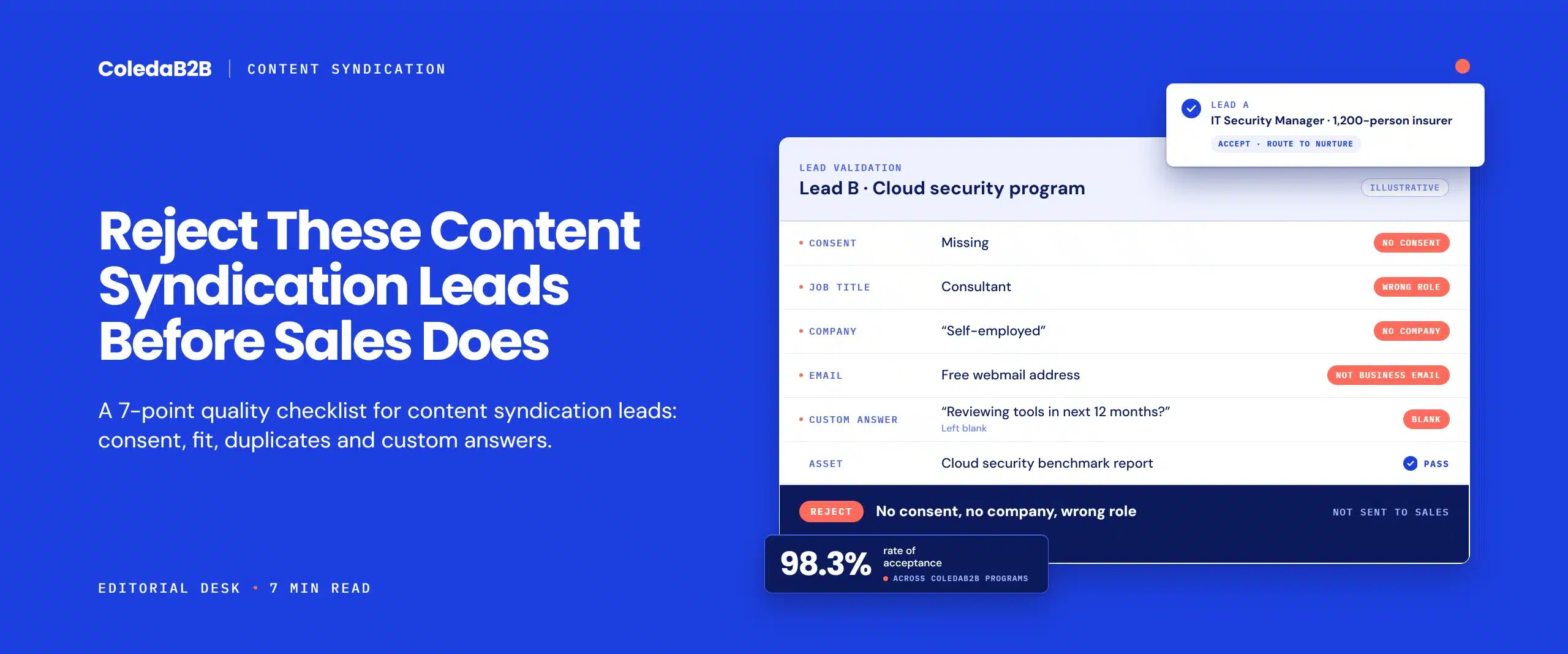
- Contact data is checked: real person, current job title, and working email or phone.
- Consent or a lawful basis for contact is recorded.
- The lead record shows what the person engaged with and when.
- An owner in sales is assigned automatically, not by hand.
- The follow-up time limit is agreed and visible in the CRM.
- Every outcome has a set reason code: accepted, SQL, nurture, or disqualified, with a reason.
Our guide to the MQL to SQL handoff covers the service-level agreement behind points 5 to 7.
Should You Still Use MQLs at All?
Forrester has argued for years that B2B teams should move away from MQLs and toward buying groups and opportunities. The reasoning is sound: purchases are made by groups, and an MQL counts one person.
Our view is practical. Keep the MQL as a quality check inside marketing, because someone still has to decide which people are worth a sales call. But stop treating MQL volume as the goal. Report on SQLs, opportunities, and the pipeline, and look at how many people from the same account are engaging, not just the one who filled in a form. Used this way, the MQL vs SQL split stays useful without becoming the scoreboard.
How ColedaB2B Delivers Leads at Each Stage
As a partner, we deliver leads at the stage your team needs: content-qualified leads, MQLs, SQLs, BANT-qualified leads, and progressive leads that build profile data over several touches.
No lead is qualified without an opt-in. Every lead goes through automated checks and a human review before delivery, so your SDRs spend their time on conversations, not on fixing data. If you need leads that already carry confirmed BANT criteria, our sales qualified leads program covers that end of the funnel.
Want to see what a delivered lead looks like before you commit? We will share a sample lead file with the fields, qualification notes, and checks your team would receive.
FAQs:
Sales does. Marketing decides when a lead becomes an MQL, but only a conversation with sales can confirm the need, authority, and timing that make it an SQL.
A sales-accepted lead (SAL) is an MQL that sales has reviewed and agreed to follow up. It sits between MQL and SQL and records sales’ commitment to act on the lead.
Yes. A demo request from a well-matched buyer, a referral, or a lead that sales finds directly can go straight to sales. Track these separately so they do not distort your MQL numbers.
BANT (budget, authority, need, timing) is the most common checklist sales use to confirm an SQL. Many teams require a confirmed need plus at least two of the other three.
The usual causes are loose MQL criteria, slow follow-up, and fit and engagement blended into one score. A missing written SQL definition makes it worse, because nobody can agree why a lead was rejected.