What is buyer intent data? It is a record of research activity that suggests a company is looking into a problem, a product category, or a vendor. It shows which accounts are reading, comparing, and searching right now. As a result, your team can focus on companies that are active instead of working through a cold list.
Definition: Buyer intent data is information about the online research behavior of people at a company, grouped at the account level, that signals growing interest in a topic, a category, or a vendor.
What Buyer Intent Data Looks Like in Practice
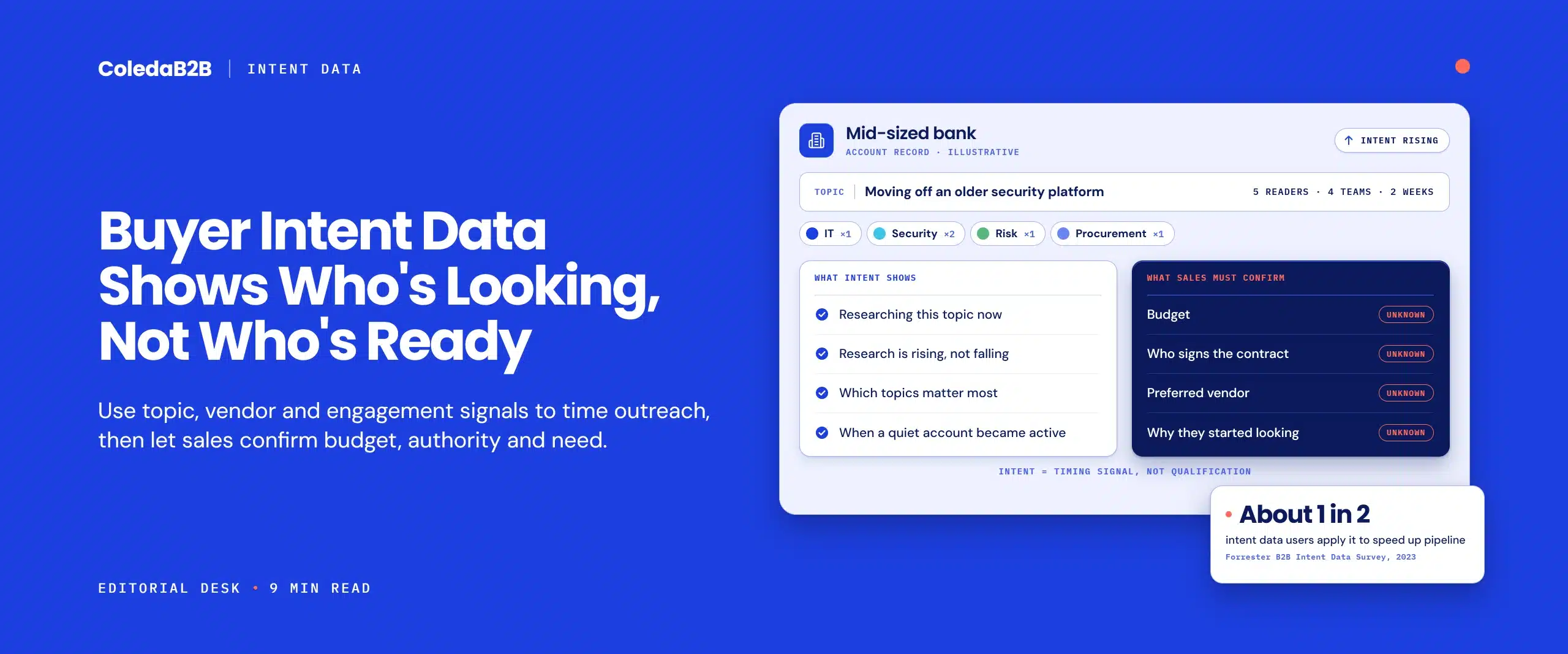
Here is a simple, illustrative example. Over two weeks, five people at a mid-sized bank read articles about moving off an older security platform. Of those five, one is in IT, two are in security, one is in risk, and one is in procurement.
None of them fills in a form. However, the pattern is still visible. A topic, a company, and a rising level of reading all line up at once.
That pattern is what buyer intent data captures. However, it does not tell you that the bank will buy it or from whom. Instead, it tells you the bank is researching something you sell and that more than one team is involved.
In short, intent data answers, “Who is looking?” Your sales team still has to answer, “Who is ready?”
Where Does Intent Data Come From?
Intent data comes from places where B2B research happens: your own website, publisher sites, review platforms, and search activity. Because of that, each source sees a different part of the journey.
We cover the ownership question in detail in our guide to first-party vs third-party intent data. Here, the focus is on what each source can actually see.
| Source | What it captures | Main strength | What to watch for |
| Your own website and emails | Page visits, content downloads, return visits, pricing page views | Shows interest in you, not just the category | Only sees buyers who already found you |
| Publisher networks and data co-ops | Reading activity across many B2B sites, compared with each company’s normal level | Spots research before a buyer reaches your site | Topic-level only, so it shows the problem, not the vendor. |
| Review and comparison sites | Category browsing, vendor profile views, comparison pages | Close to a buying decision | Covers only buyers who use those sites |
| Owned publisher audiences | Readers who register and engage with specific content on a known site | Named, consented contacts tied to a topic | Reach depends on the network’s audience size. |
| Search and ad activity | Keyword research and ad engagement, matched to companies | Wide coverage | Matching companies to activity can be loose. |
For example, Bombora describes its data as a co-op of more than 5,000 B2B websites, with data collected with consent. Its scoring compares a company’s current reading with its own normal level, so a spike stands out from routine activity.
In fact, that idea matters more than any single vendor. For instance, a company that always reads about cloud security is not “surging.” A company that suddenly reads three times more than usual might be.
Intent Data Types: Topic, Vendor, and Engagement
Sources tell you where data comes from. Types, on the other hand, tell you what it means. Most programs work with three.
- Topic intent. An account is researching a subject, such as “zero trust” or “payroll compliance.” This is the earliest and widest signal.
- Vendor intent. An account is looking at specific vendors, including you or a competitor. This usually comes from review sites or your own website.
- Engagement intent. A known person at an account is interacting with your content, emails, or events. This is the narrowest signal, but the easiest to act on.
In practice, the strongest programs combine all three. First, topic intent finds accounts early. Then vendor intent shows who is close to a shortlist. Finally, engagement intent gives your team a named person to contact.
What Buyer Intent Data Can and Cannot Tell You
Intent data is useful when teams know its limits. In fact, most frustration with it comes from expecting it to do a job it was never built for.
| It can tell you. | It cannot tell you |
| Which accounts are researching a topic now? | Whether they have a budget |
| Whether research is rising or falling | Who will sign the contract? |
| Which topics an account cares about most | Whether they prefer you or a rival |
| When a quiet account becomes active | Why they started looking |
So treat intent as a timing signal, not a qualification. It tells you when to start a conversation. However, the conversation itself still has to confirm need, authority, and timing.
How Each Team Uses Buyer Intent Data
The same signal can drive four very different actions, depending on who receives it. This is where most teams lose value, because they send every alert to sales and stop there.
| Team | What they watch | What they do with it | What good looks like |
| Marketing | Topic surges across the target account list. | Moves active accounts into ads and email built around the topic they are reading | Spend shifts toward accounts that are already researching. |
| SDRs | Accounts with rising intent and a good company fit | Prioritises outreach and opens with the topic, not a generic pitch | Fewer calls, better first conversations |
| Sales (account executives) | Vendor intent and competitor research on open deals | Adjusts the deal plan, brings in proof points, involves the wider buying group | No surprises late in the deal |
| Customer success | Existing customers researching alternatives or new categories | Flags churn risk early, or opens an upsell conversation | Renewals protected, expansion found sooner |
Notice the pattern. Marketing uses buyer intent data to decide where to spend. SDRs use it to decide who to call first. Meanwhile, sales and customer success use it to protect deals and accounts they already own.
What the Research Says About Intent Data Results
Intent data is now common. Even so, results vary a lot. Forrester’s Q1 2023 Global B2B Intent Data Survey offers a useful reality check.
According to Forrester’s intent data survey findings:
- More than 85% of intent data users said they achieved benefits from it.
- More than 70% use more than one intent provider.
- Only about half use intent data to speed up the pipeline, which suggests many teams use it for targeting but stop before sales action.
- The most common challenge was identifying the right decision-makers inside an active account.
That last point is telling, because an account-level signal is only half the job. Someone still has to find and reach the people doing the research.
How to Start Using Buyer Intent Data in Four Weeks
Also, you do not need a large platform to begin. Here is a simple rollout that most teams can run with their current tools.
- Week 1: Pick five to eight topics. Choose topics tied to the problems you solve, not your product name. Buyers search for problems first.
- Week 2: Match intent to your account list. Score active accounts by fit and intent together. A surging account outside your target market is still a poor fit.
- Week 3: Agree one action per team. Use the table above. Decide who receives which signal and what they should do within how many days.
- Week 4: Review and adjust. Check which accounts moved, which alerts nobody acted on, and which topics produced real conversations. Then drop the weakest topics.
After that, review topics every quarter. Buyer interest moves, and your topic list should move with it.
Accuracy, Privacy, and Freshness
Three questions come up in almost every intent data project.
Accuracy. Account-level signals are directional, not exact. They get more reliable when several sources agree, and when a spike is measured against an account’s normal level. Therefore, check one source against another before acting on a single alert.
Privacy. Most intent data works at the company level. Even so, the way a provider collects it still matters. In the UK and EU, contacting a person usually relies on consent or legitimate interests. The ICO’s guidance on legitimate interests explains the balancing test that applies. So ask every provider how it collects its data and what consent sits behind it.
Freshness. Intent fades quickly. For example, a spike from six weeks ago may describe a decision the buyer has already made. For that reason, most teams act within days of a signal, not weeks.
How ColedaB2B Uses First-Party Intent
As a partner, we run intent-based marketing on top of our own network of seven B2B publishers, including TechsterHub, SalesTechSpace, and MarTechSpace. When people from your target accounts read related content on these sites, that activity becomes a first-party signal, tied to real readers who opted in.
We then add a human check before any lead reaches you. As a result, your team gets named and consented contacts from accounts that are already researching, not a list of anonymous company names. We are also GDPR and CCPA compliant, and we never qualify a lead without an opt-in.
To see what this looks like for your market, see which buying signals predict a real cycle, or talk to us directly.
Want to know which of your target accounts are researching right now? Share your account list, and we will show you which ones are engaging with related content across our network.
FAQs:
It is directional rather than exact. Accuracy improves when several sources point the same way and when activity is compared with an account’s normal level. So, treat a single alert as a reason to look closer, not as proof of a deal.
First-party intent data is activity you collect directly, such as visits to your website, email clicks, or content downloads. It shows interest in your company specifically, but only from buyers who have already found you.
It can be, but it depends on how the provider collected it. Company-level data carries less risk than personal data. Before contacting individuals, check the provider’s consent process and the lawful basis you rely on, such as consent or legitimate interests.
Sales teams use it to decide which accounts to contact first and what to talk about. Account executives also watch competitor research on open deals, so they can respond before a rival gets ahead.
Most providers update scores weekly, and some update daily. Interest also fades quickly, so a signal is most useful in the first few days. Review your topic list every quarter to keep it current.